
My first newsletter of the year for the Barron’s Investor Circle discussed how AI would be the most important macro factor to watch this year.
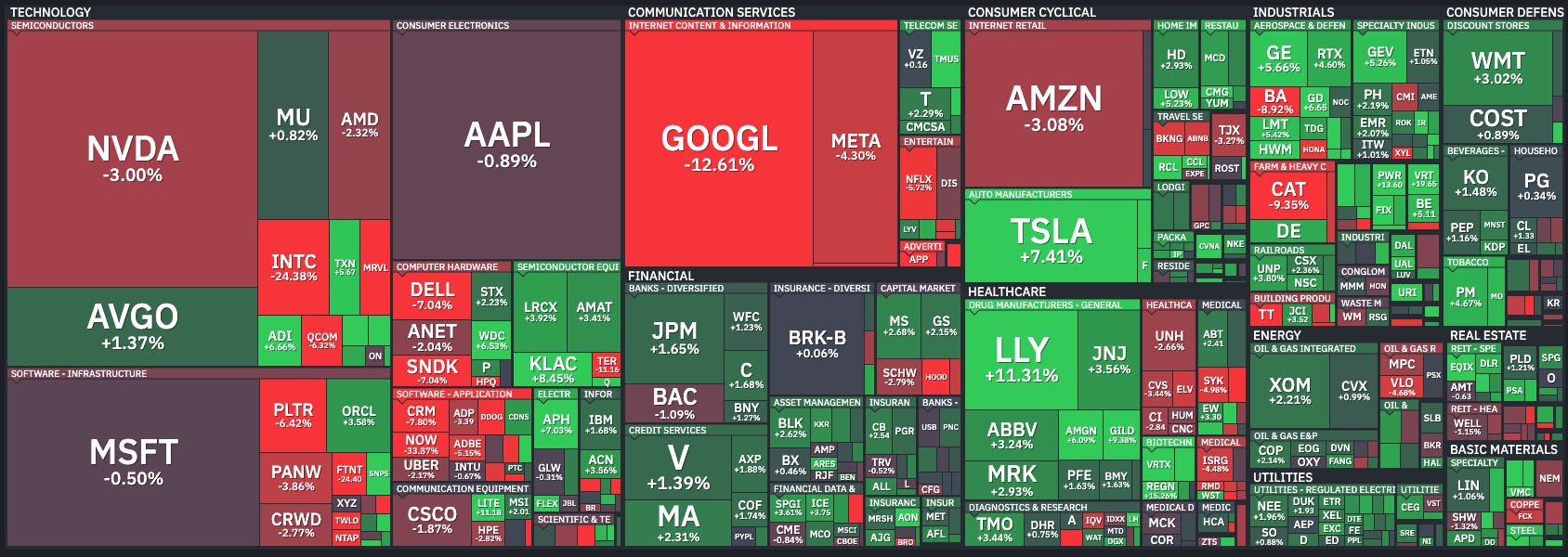
We’re seeing signs of that playing out everywhere right now. Let’s start with the stock market. A sharp sell-off in AI-related stocks this past week, headlined by Alphabet’s largest one-day decline in history and Intel’s nearly 30% loss in a single session, dragged down the broader market indexes.
But take a look at this heat map from Finviz. There were more than 300 S&P 500 stocks in the green this week, but the index fell 0.6%. This reminds us that while a broad swath of stocks rising is certainly not a bad thing, anyone passively investing in the S&P 500 is inherently rooting for AI growth to drive the largest stocks in the index higher. Because when those stocks don’t participate in the rally, it’s much harder for the S&P 500 to chug higher.
Then there’s the bond market. There have been many reasons for the rapid rise in interest rates. Higher oil and inflation fears are certainly in there somewhere. But October’s market action shows the AI growth story is clearly a big part of what’s moving around rates.
In October, WTI Crude oil gained 15%. The 10-year Treasury yield fell 0.37 percentage points, its largest one-month decline since December 2023. So no, higher oil isn’t the only thing moving around the 10-year Treasury yield. And lower oil wasn’t the catalyst that finally ended the bond market selloff. It was AI. Take a look at the Nasdaq. The Nasdaq Composite fell 5.3% in October as fears over how tech companies will fund the AI buildout percolated.
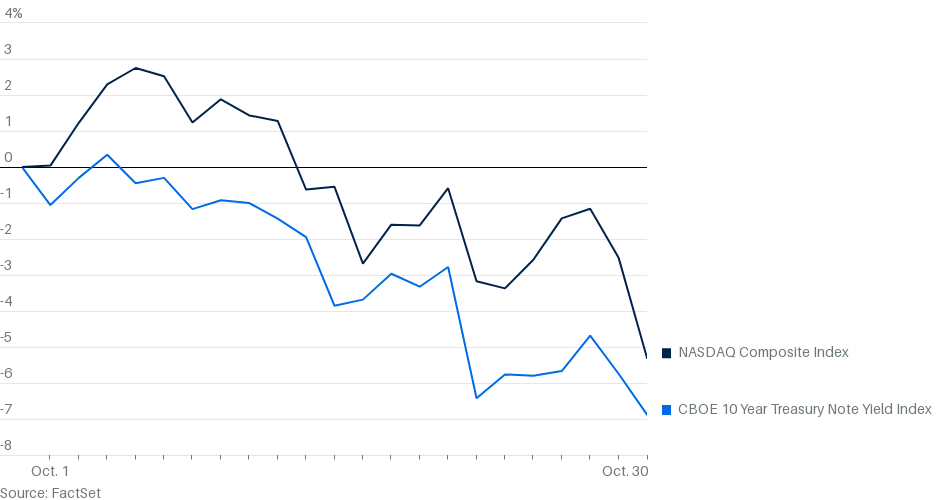
So yes, even the borrowing costs for things like your mortgage rate that key off the 10-year Treasury yield are being influenced by investor confidence in the AI growth story.
And perhaps rightly so. There’s a big debate on exactly how much of economic growth is being driven by AI right now. We won’t get into that here. Just check out this chart from Charles Schwab’s Kevin Gordon, which shows info processing equipment (key parts of the AI buildout) is contributing to the real GDP at one of its highest levels ever.


As I noted last week, there’s certainly a version of the AI bubble popping that won’t be so bad in the long run. But for now, the key question for all of us remains what any risk means for the sustainability of the AI buildout. Whenever that path comes into question there are ripple effects hitting many areas of the market and the overall economic story.
In the Circle
At the Barron’s Investor Circle, our subscription product focuses on engaging directly with readers. We provide exclusive stock picks and technical analysis to help investors navigate evolving markets.
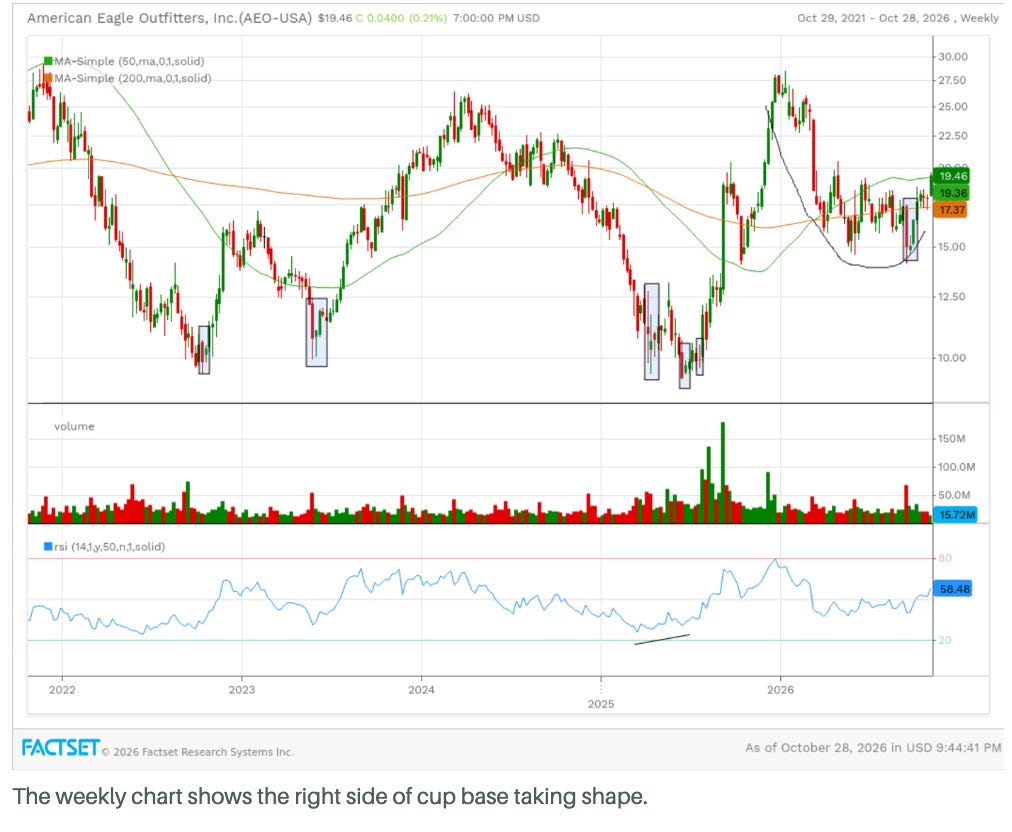
Our senior technical analyst Doug Busch writes a chart of the week for subscribers. This week he had his eyes on American Eagle. Here’s part of his take:
“AEO price action is now testing the very round $20 handle, which previously served as distribution resistance on April 21 via a bearish engulfing candle. This stock could trade toward $24 by the first quarter of 2027, a 23% gain from current prices. Remain bullish above $18. American Eagle Outfitters was trading around $19.75 Thursday.”
Here are three stories that caught my eye at Barron’s this week…
Al Root explains how China began dominating its own EV market.
Andrew Bary digs into a way for investors to borrow against their investment portfolios.
Half of the ‘Big Money’ managers told Barron’s the AI boom has years left to run.
And in case you missed our latest stock picks from Barron’s Investor Circle…
Like your work Josh, wish this substack was more than once a week 👍🏼